Cybrion

An AI powered security testing platform that brings the whole engagement cycle into one operator workspace: scoping, AI agent coordination, tool execution, evidence validation, finding management, and a report ready to hand over.

  • Coordinated AI agent swarm
  • The operator stays in charge
  • Validated findings
  • Self-hosted
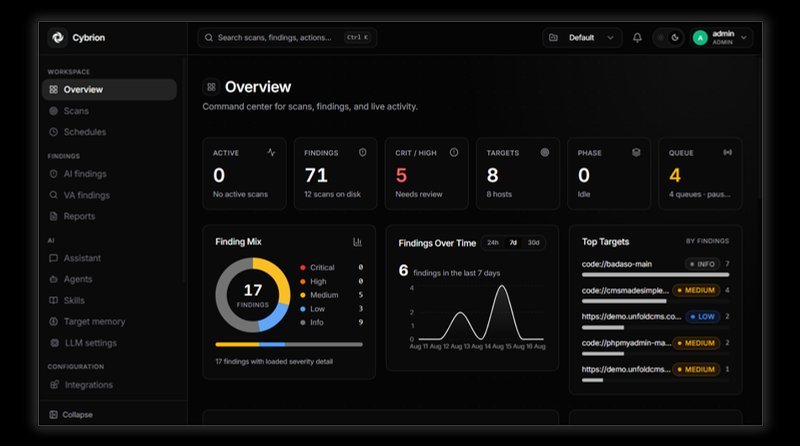
cybrion / overview
Cybrion operator workspace
8

Testing modes

4

Roles in the swarm

3

Depth levels

1

Operator workspace

The shift

From manual pentest to AI powered pentest

TODAY

What security teams keep running into

  • Penetration testing still leans heavily on manual work
  • Separate tools make findings hard to bring together
  • Vulnerability validation eats time spent suppressing false positives
  • Documentation and reporting often become the bottleneck
  • Testing demand keeps growing while expert headcount does not
WITH CYBRION

What changes once AI agents join the workflow

  • AI agents automate scanning, analysis, and finding prioritisation
  • The whole pentest process runs on one integrated platform
  • Evidence validation raises accuracy and confidence in findings
  • Central finding management makes tracking and collaboration easier
  • Professional security reports are produced far faster
  • The team focuses on strategic decisions instead of repetitive work
Why Cybrion

Three things that make the flow different

AI driven automation

AI agents run the repetitive pentest work, from scanning and analysis to vulnerability prioritisation, so a security assessment finishes sooner.

Validated findings

Evidence validation and smart analysis push false positives down, so what reaches the team is genuinely worth acting on.

End to end pentest flow

From scoping and testing through to finding management and reporting, the whole cycle runs on one platform.

How it works

An agent swarm that stays under operator control

OPERATOR You stay in charge scope · mode · depth · control
PRIMARY / ROOT AGENT Owner of the engagement picks actions · delegates · correlates
SUB-AGENT A Recon and services discovery · enumeration
SUB-AGENT B Web and endpoints targeted testing
SUB-AGENT C Focused lead one path, deeper
INDEPENDENT VERIFIER Cross-examines findings confirmed · rejected · inconclusive
SHARED SCAN CONTEXT targets · evidence · notes · vulnerability records

Parallel agent execution stays governed by a central coordinator, a shared engagement context, independent verification, and lifecycle control.

ROLE RESPONSIBILITY VALUE TO THE OPERATOR
Primary / root agent Holds the chosen methodology, decides the next step, delegates bounded tasks, and correlates results. One coordinator accountable for the whole engagement.
Specialised sub-agent Runs narrow work in parallel such as discovery, enumeration, analysis, or focused validation. Broad coverage without stalling other investigation paths.
Independent verifier Rechecks important findings from a sceptical position, then returns the verification result. A cross-examination pass before the operator accepts a finding.
Shared scan context Links approved targets, notes, events, evidence, and vulnerability records across the swarm. Collaboration that is tracked, not a scatter of separate chat sessions.
Testing modes

Eight modes for different classes of asset

01 Web and API Single target, wildcard or multi target, browser based DAST URL, domain, app login, OpenAPI, Postman, HAR, and Burp context
02 Mobile Android APK, iOS IPA, plus dynamic testing for both APK or IPA files, package or bundle ID, and an approved dynamic test environment
03 IoT and firmware Assessment of embedded devices and firmware blobs Firmware images, extracted filesystems, services, configs, packages, code, and binaries
04 Infrastructure External perimeter, internal network, Active Directory Hosts, IPs, CIDRs, domain controllers, jump hosts, VPN profiles, and approved credentials
05 Cloud AWS, Azure, and GCP assessment Account or project context, regions, assumed roles, and read-only credentials
06 OT, ICS, and SCADA Assessment of authorised industrial environments Process context, maintenance windows, safety checklists, forbidden actions, and operator contacts
07 Vulnerability assessment Network services, web applications, default port audits Hosts or CIDRs, web targets, service checks, and supported scanner runs
08 Source and privacy Code review (SAST) and privacy risk (PII/PHI) Source ZIP or a connected GitHub and GitLab repository, with manual review
Engagement control

You set the boundaries, the agents work inside them

Targets and context

URLs or domains, hosts and CIDRs, binaries, repositories, cloud context, API specs, HAR, Postman, and Burp exports.

Authentication and access

Browser credentials, cookies, bearer or custom headers, secondary test accounts, jump hosts, VPN, cloud roles, and stored credentials.

Methodology

Passive only or active allowed, Quick, Standard, or Deep depth, selected phases, and the relevant security skills.

Boundaries

Out of scope assets, paths, ports, accounts, and tenants, forbidden actions, scan windows, and the emergency stop procedure.

Output

Report language, observation capture, severity filters, report logo, and notification settings.

Every critical action still passes human approval

Agents run the workflow, security experts review, steer, and approve the important actions and findings.

Audit ready

A pentest that keeps running, not an annual agenda item

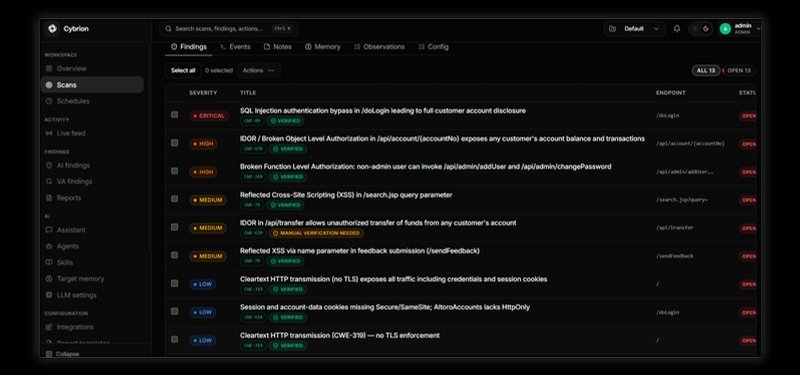
Every test carries a clear audit trail: scope, methodology, timestamps, findings with CVSS ratings, and remediation status. Ready to share with auditors or regulators without rebuilding it first.
  • Scope
  • Methodology
  • Timestamp
  • CVSS
  • Remediation status
cybrion / findings
Validated findings list in Cybrion

PDF report

A comprehensive document in a professional format, ready to hand over.

Remediation validation

Retesting to confirm that a fix genuinely closes the gap.

Structured data export

Findings in a format other systems can read.

Full audit trail

Administrative records from the start of the engagement to the end.

For enterprise needs

Installed in your environment, wired into the flow you already run

Multi mode testing

Assesses web, API, mobile, firmware, infrastructure, cloud, OT, source code, and privacy risk.

Flexible integration

Connects to the security tools and workflows you already run, without replacing your ecosystem.

Human supervised

AI agents run the workflow, security experts review and approve critical actions and findings.

Self-hosted

Run it inside your own environment and keep sensitive security data under full control.

Deployment A one line installer, Docker, or Docker Compose. The /data volume is preserved for configuration and scan data.
AI routing Curated and custom models across hosted providers, model routers, local runtimes, and OpenAI compatible endpoints. A separate vision provider is optional.
Local runtime Supports operator owned model IDs exposed through a reachable Ollama, vLLM, or SGLang deployment.
API Interactive documentation at /api/docs and raw OpenAPI at /api/openapi.yaml. External clients use a personal bearer API key.
Network access Import an OpenVPN or WireGuard profile, validate routing and DNS, and drop the connection once the scan finishes.
SCHEDULE A DEMO

Run an AI powered pentest across your applications and infrastructure

Find vulnerabilities sooner, validate security risk, and speed up remediation before an attacker gets the chance to use it.

  • Answer within one working day
  • NDA available
  • Self-hosted deployment
WHATSAPP